We've been asked this a lot, and our answer keeps changing. Here's where we are today.
Mubone is a way of making music with the space around you. You point somewhere and make a sound, and the sound stays there. Later you, or someone else, can go back to that spot and play it again, stretch it, scatter it, mix it with something new. Over a performance a room slowly fills up with sound that people have left in it.
It started in 2018 as a sensor taped, then bolted, to Kalun's trombone, with software Travis wrote to go with it. The trombone turned out not to matter much. Since then a dancer, a singer and a percussionist have all played it, and the sensor has been on hands, heads and a clarinet. So these days we use the word for a few things at once: the tools, and the way of playing them.
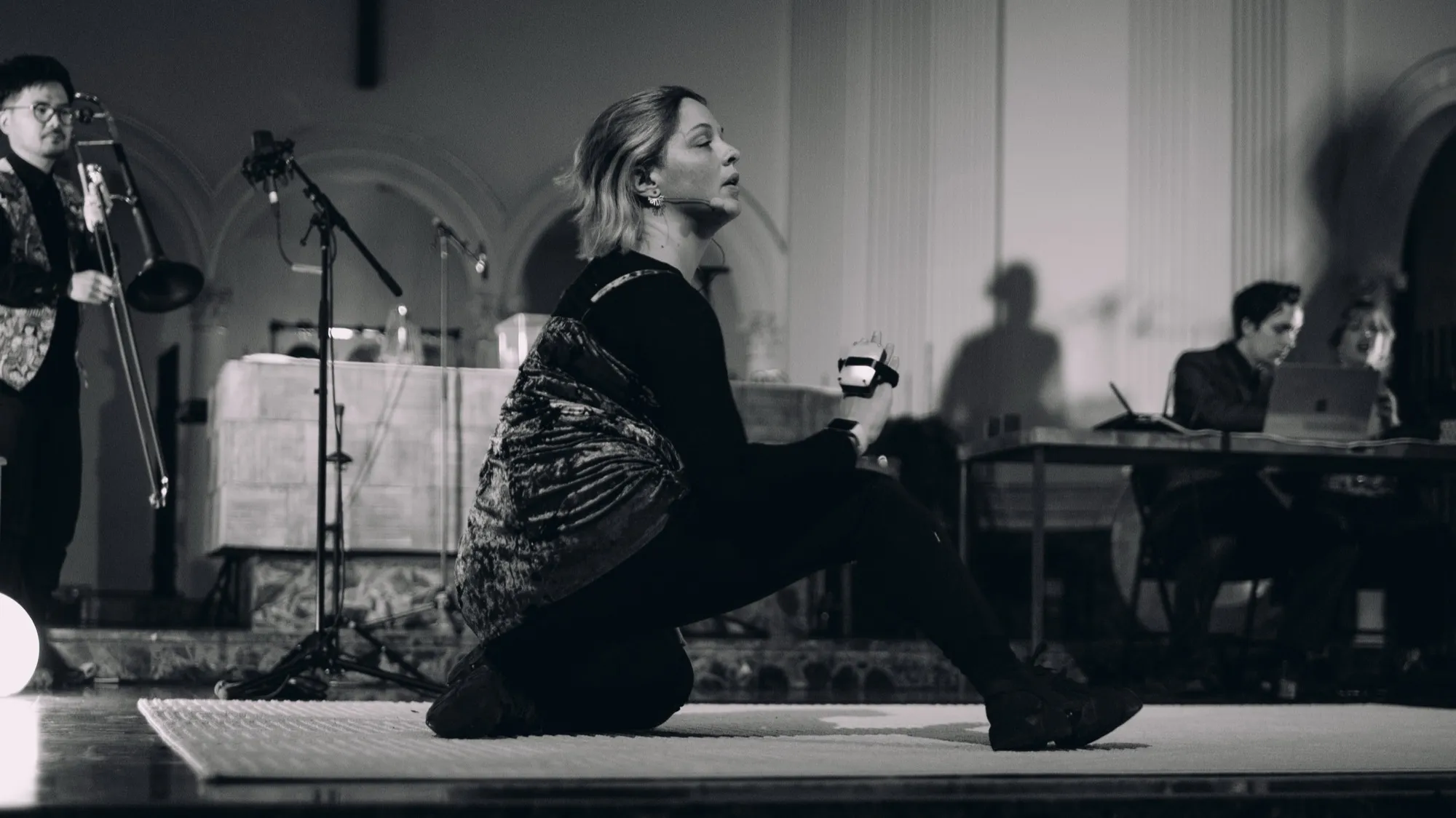
What it isn't: a headset, an app, or AI. Everything happens live, in a real room, with real people in it.
How it works (right now)
The gear changes every year or so. The idea underneath has stayed the same.
Leave a sound somewhere
A small motion sensor, the same kind of chip that tells your phone which way is up, sits on an instrument or on the person playing. It knows which way it's pointing. While you play or sing, the software remembers which direction each bit of sound came from.
Go back and find it
Point the same way later and you hear what you left there. Retrace your movement and you get something like the original back. Move differently and the same material comes out in a new order, shaped by how you move. (For the curious: it's granular synthesis, with the sensor deciding which grains play.)
Drawing with it
There are two basic strokes. A line stroke lays a sound along a path, like drawing with a pen. A grain stroke scatters it so you can scrub through it any way you like. The thing we practise most is what we call a gesture-sound: a movement with a sound inside it. Once everyone in the room has heard one, coming back to it means something.
Seeing it
Since 2025, Travis's projection mapping draws each stroke on the walls where it was made. By the end of a show you can see everything that's been left in the room. Then we usually hand the audience a sensor and let them have a go.
Playing together
For years only one person could play at a time. In 2026 we got three sensors running together, and the system started paying attention to where everyone stands. Huddle up, spread out, wander off: it all changes the music. This is the part we're most excited about, because it's also what makes mubone something other people can learn.
Who plays it
Kalun and Travis built it, and the mubone collective is its flagship ensemble. But more and more people are picking it up:
- Clarinettists in the NYU New Music Ensemble, in Movement Etudes for Improvisors (2019)
- Singers, saxophonists, flautists and others at the Britten-Pears Young Artists Programme in Snape (2023–24)
- Composers and performers in open workshops at the Darmstadt Summer Course (2023, 2025)
- Students at the Dartmouth Music Festival (2026)
- Director and artist Gabo Champagne, who used it in Neiges bleues during a residency at LA SERRE in Montréal (2026)
We keep running workshops, and the simulator lets anyone try it in a browser. If you'd like to work with it, write to us.
How we got here
2018
Kalun and Travis start tinkering with a couple of Wii remotes. The first prototype goes on video.
2019
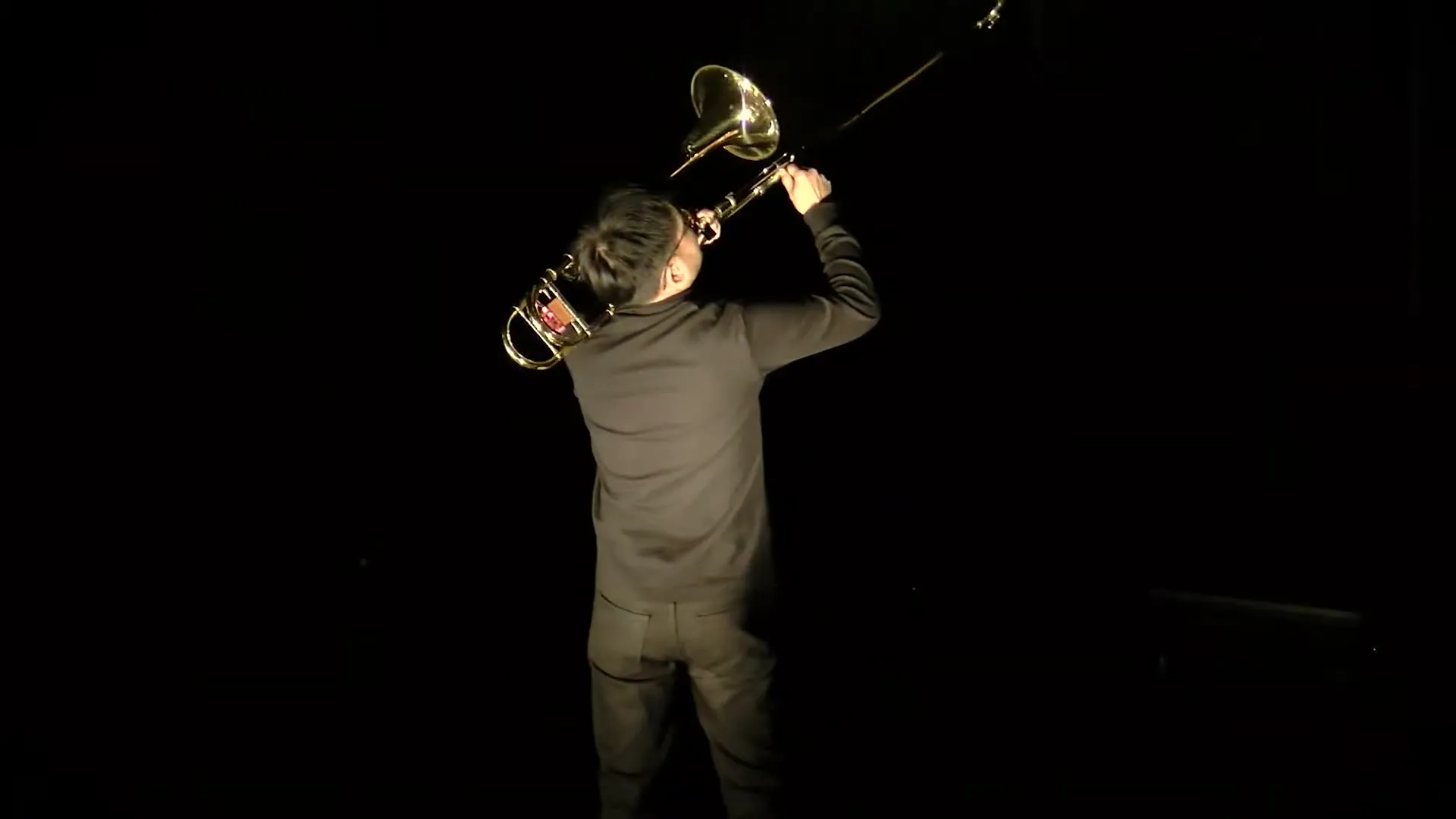
A paper and demo at MOCO (Movement and Computing). First public show at the NYC Electroacoustic Improvisation Summit. A version for clarinets in Movement Etudes for Improvisors at NYU.
2021
Garcia, the first piece made for mubone, with choreography by Bettina, at Le Vivier.
2022
A paper and artwork at NIME. Garcia at IRCAM. The first Conversations with Space and Architecture, in Montréal. The sensor goes through a lot of forms: home-built boards, an x-IMU, a ring.
2023
Migrations at CIRMMT, on more than forty speakers. An honourable mention for the Kranichstein Prize at Darmstadt, and workshops there.
2024
Kirsten fills a barley kiln with sound at the 75th Aldeburgh Festival.
2025
Projection mapping, first tried at Perte de Signal in Montréal. Three nights in a Copenhagen boiler room with Kirsten and Sara. The Kranichstein Music Prize at Darmstadt.
2026
Three of us on the system at once in Love Letters to a Third Culture Kid (Flux Festival, 9 October). New sensor boards on the way.
Try it yourself
The mubone simulator runs in your browser. Sound from your microphone gets painted onto a sphere around you, and you play it back by pointing with your mouse or finger. On stage it's the same software, with a sensor instead of a mouse and a ring of speakers instead of headphones.
Papers
- Travis West and Kalun Leung, “Early Prototypes and Artistic Practice with the Mubone,” NIME 2022. Read it
- Travis West and Kalun Leung, “Mubone: An Augmented Trombone and Movement-Based Granular Synthesizer,” MOCO 2019.
Talks and demos
IRCAM Forum, Paris (2022) · CIRMMT, Montréal (2022, 2023) · McGill Jazz Forum · Darmstadt Open Space (2023, 2025) · Dartmouth Music Festival (2026)
Want a demo, a workshop, or to borrow it for a residency? Write to us. We love showing it to people.